
This article has been reviewed and updated with current information, new examples, and the latest academic requirements for 2026
SQ3R, PQ4R, Pomodoro, active recall, spaced repetition, interleaving, dual coding, and elaborative interrogation are some top study techniques. They will help you enhance focus, subject understanding, and long-term memory retention effectively.
If you are a student, then you might spend several hours studying, but still find it difficult to recall important information during your exams. This happens because the way you study matters more than how long you study. Reading through your book or simply highlighting key points may seem like the most productive way of studying, but it is not the most effective way of remembering information for long periods of time. Mainly, to improve your academic performance, you must use the most appropriate study techniques that will engage your brain. When you use the study materials in a structured way and follow the right learning techniques, you can understand the information better and retain it effectively. Also, you can make your study time more effective and less stressful.
In this blog, we have discussed 8 powerful study techniques that will help you retain the information you learn in your memory and excel in your academics.
Best Study Techniques for Retaining Information in Memory
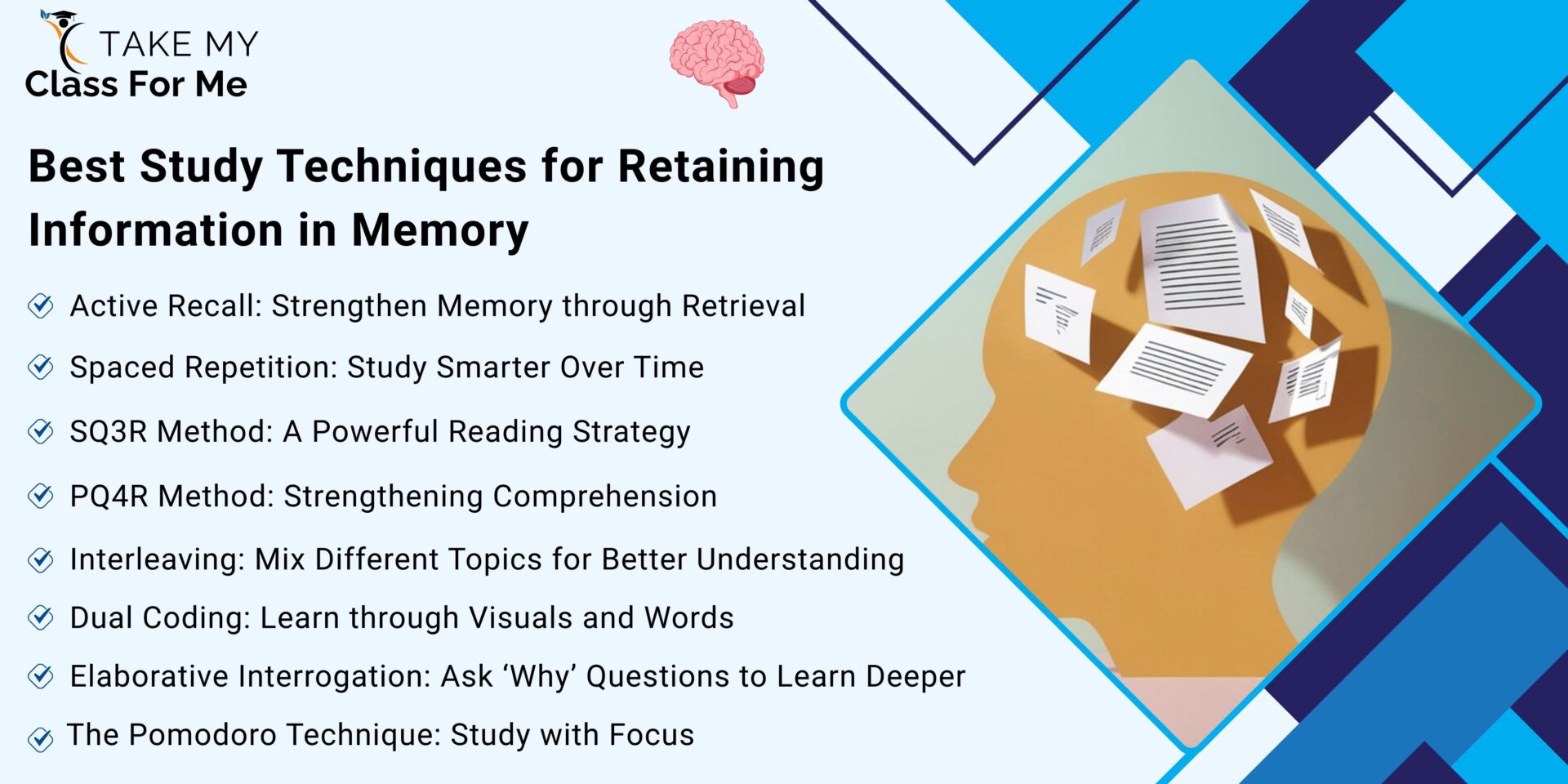
Here are some proven study techniques or strategies that will be beneficial for students like you in learning effectively and retaining information in memory.
1. Active Recall: Strengthen Memory through Retrieval
Active recall is one of the best techniques to aid you in remembering what you learn. Rather than just re-reading your notes, recall what you have learned. In general, to actively recall the information from memory, you can use flashcards, answer practice questions, write a summary of what you have learned from memory, or even teach someone else about a particular topic. Especially when you repeat this process several times, your brain will continue to strengthen your memory every time you recall something. Overall, this method will help you learn better and retain your memory for a long time.
2. Spaced Repetition: Study Smarter Over Time
Spaced repetition is a study technique in which you review your material in stages multiple times over days or weeks, instead of trying to learn everything all at once. Here is how you should apply spaced repetition
- Study new material today.
- Review it again after one day.
- Revisit it after three days, then a week later.
- Continue periodic reviews until the exam.
By doing this, you can reinforce your learning before you begin to forget. Many students combine this technique with online practice tests, and some even search for assistance from subject experts using phrases like take my online quiz.
3. SQ3R Method: A Powerful Reading Strategy
The SQ3R method is a structured reading strategy you can use to understand and remember information better. SQ3R stands for Survey, Question, Read, Recite, and Review. The following are the key steps of the SQ3R Method
- Survey: Scan the chapter or reading material. Pay attention to headings, subheadings, images, and summaries. This will give you a better understanding of the information before reading it.
- Question: Change the headings into questions. This will make it easy to concentrate on the learning material.
- Read: Carefully read the material and try to answer the questions you created.
- Recite: Explain the concept in your own words without referring to the text.
- Review: Extensively review the material after some time to remember it better.
In simple words, the SQ3R method encourages active reading and helps you retain important information more effectively.
4. PQ4R Method: Strengthening Comprehension
This method is almost the same as the SQ3R method, except for an additional step that allows you to think more critically about what you are learning. PQ4R stands for Preview, Question, Read, Reflect, Recite, and Review. These are the steps of the PQ4R method
- Preview: Quickly scan the learning material to comprehend its structure.
- Question: Develop questions about the material to guide your reading.
- Read: Carefully read the material to find answers to the questions you have generated.
- Reflect: Relate the new information to the old information that is already stored in your brain.
- Recite: Summarize the new information in your own words.
- Review: Deeply review the new information to strengthen your memory of it.
This is a good study technique that will help you better understand a concept rather than memorizing facts.
5. Interleaving: Mix Different Topics for Better Understanding
Interleaving is a technique of studying different topics or subjects at one go instead of focusing on a single topic or subject for a longer period of time. For instance, rather than studying math for three hours a day, it is better to study math, science, and language together. This technique will not only enhance your problem-solving abilities but also strengthen your knowledge and reduce mental fatigue. Although it may feel harder at first, it will train your brain to apply knowledge more effectively in varying situations.
6. Dual Coding: Learn through Visuals and Words
Dual coding is a studying technique that helps you comprehend the material better by using both pictures and words. The rationale behind dual coding is that the brain processes pictures and words differently, thus improving memory retention when both pictures and words are used. For instance, you can use mind maps, draw diagrams, charts, and pictures in your notes. This technique is particularly helpful when the course to be studied has complex concepts. Moreover, in online classes where many assignments are involved, some students seek online services such as take my online class for me to manage deadlines more easily and handle the tasks effectively using visuals and words.
7. Elaborative Interrogation: Ask ‘Why’ Questions to Learn Deeper
Elaborative interrogation is another best study technique that allows you to ask why and how questions regarding what you are learning. For example, you may ask why something works or how it relates to what you already know or why it is important. By making these connections, you can improve your level of understanding and memory. Overall, this method helps you learn more deeply and go beyond simply memorizing facts.
8. The Pomodoro Technique: Study with Focus
The Pomodoro Technique is a time management method that will help you concentrate on your studies and avoid burnout. Here is how you should follow this technique
- First, select a task you want to complete.
- Next, set a timer for 25 minutes and study for this period with complete concentration.
- After this, take a short break of 5 minutes.
- Once you finish four sessions, take a long break of 15-30 minutes.
In this manner, you can study in short intervals to keep your mind sharp and be more productive. But if you are under pressure due to academic requirements, you may seek professional online class help with phrases like “pay someone to take my online class.”
Conclusion
Effective learning is not just about spending more time with your books; it is about using the right studying techniques. Generally, the active learning techniques that are suggested in this blog will help you learn faster and remember information longer. Furthermore, by using the appropriate studying strategies in your daily life, you can improve focus, understand concepts better, and perform well in your exams. If it is challenging for you to comprehend any subject, you can approach the skilled tutors from our team and get customized guidance. They will assist you in mastering your course.
FAQs
1. What is the best study technique for retaining information?
Active recall and spaced repetition are the most effective ways of studying, which help you retain the information for a longer period of time.
2. How does the Pomodoro Technique help you study effectively?
The Pomodoro Technique helps you study more effectively by dividing your study sessions into small intervals, keeping you alert and reducing tiredness, and increasing your productivity.
3. Can combining multiple study techniques improve learning?
Yes, combining multiple study techniques, such as active recall, spacing, and interleaving, will help you improve learning and retain information in memory effectively.